I don’t have to have my whole life planned out. Living with someone who is constantly stressed about their future just compounds my own worries. I try to wake up every day and think about the things I can gain rather than the opportunities I’m missing, but I’m not always successful.
I’ve read a lot about adoptees going back to Asia recently and there are a lot of stories about Korean adoptees repatriating. Obviously, that’s not a choice for Chinese adoptees, but I like reading about people’s stories. (Note: there are some stories about Chinese adoptees returning to China, but there just aren’t as many narratives out there because the peak wave of Chinese adoption happened later). I was looking one adoptee’s blog about how he quit his corporate job and started travelling. It was really interesting to see where he’d been. Belize, Costa Rica, Nicaragua, Ecuador, Thailand, Korea, Cambodia, China, etc. His list went on and on. His name is Troy and he grew up in Colorado. He worked as a producer, consultant, English teacher, etc. But I noticed there weren’t any recent posts. I assumed he got tired of blogging. But, because I can’t let things go, I looked him up on LinkedIn. Maybe he had changed jobs again. Nothing there. But a Google search showed he had committed suicide a few years ago. Nobody can really know what goes through someone’s head when they decide to do this. But sometimes I worry that maybe one day I’ll end up like this too.
I over-think what my life has to be. And when I put myself in his shoes I wonder if I’ll end up the same way. Trying to travel and find out my “purpose” and getting even more confused. But I also look at stories like NikkiOften and get more hopeful. Nikki returned to Korea after being adopted and worked there through her twenties. She was able to reunite with her birth family and figured out she had nine siblings. She works in California now and makes cartoons about her life. Some are related to adoption and some are just everyday worries or silly thoughts.
Lisa Wool-Rim Sjöblom also makes similar comics. She’s a Korean adoptee who lives in Sweden. She started the #IAmNotaVirus campaign and does a lot of work around adoptee advocacy and writes/illustrates her own books. This started to tumble into a list of adoptees I like to follow, but I’ll just continue.
I also finished a book by Xinran about the One Child Policy and how it affected birth mothers in China. It’s called Messages from an Unknown Chinese Mother and the author records her interviews of women from the late 1990s to mid-2000s. Some of the stories were so brutal. Many women had to kill their babies themselves, have a midwife do it, or abandon them, especially those who were in more rural areas. It wasn’t that they didn’t want a daughter, but rather that they couldn’t keep one. I think being abroad and also reading stories like this makes me realize that adoptees can never really count on “closure”.
Jenna Cook’s story also was really emotional to read about. She tried to find her birth parents and although 50 families tried to reach out, none of them were her biological ones. She now is a Sociology doctoral student at Harvard and does a lot of research about gender, fertility, immigration, and trauma. I don’t see myself staying in higher education, but I really appreciate all the work that other scholars do in areas like this.
One of my problems is that I try to think about all the possible outcomes of something before it even has happened. What if I waste my life at a dead-end job? What if I fail? What if I don’t get the opportunity I applied for? What are my backup options? Am I making the right decision? Is there a right decision? What if I don’t have friends? What if I’m not doing enough? And then I end up making spreadsheets and lists of all the various paths I can take. And sometimes this has worked out well. Applying for scholarships and colleges meant that I needed to have that kind of information. But right now? It’s more stressful than helpful. I don’t even know if I will end up liking TEFL. But I keep looking up graduate programs or fellowships or alternative teaching certificates and I can’t stop myself from snowballing. Would I come back to the states for a few years and get certified and then go abroad again? Should I have just majored in English education like I had planned? But then I wouldn’t have been able to study abroad or take more Asian American Studies courses. But will my friendships and relationships last if I keep moving around?
Maybe I’d like user-interface design? I joined a bunch of online groups and asked questions to people who work in the field. I even went to a few online workshops for it. It’s not like I felt drawn to the job, but wouldn’t it make sense? Or what about getting into a graduate program in Korea? Or what if I want to go back to China? Or what if I do a Fulbright or Peace Corps or graduate degree somewhere else? I spend too much time on LinkedIn or job boards or fellowship websites comparing myself to others. I get frustrated because I want stability, but I also have no idea where to go from here. And I compare myself to my sister even though the work that she is doing is not appealing at all to me. I cannot work in local politics and listening to her meetings just reinforces that. So, here’s to figuring something out this year. Thanks for reading this far. It’s almost 2 am and I just needed to get all of this off of my chest.
I’m often bothered by this notion that literature shouldn’t be political. How can you separate art from the world it’s created in, and why would you want to?
Lisa Ko 2017
*SPOILERS AHEAD*
I originally started The Leavers in December. I’m not sure why I was dragging my feet to finish it, but I’m glad that I picked it back up again. Deming, or Daniel, is a Chinese American child who is separated from his birth mother when she is deported back to China. He subsequently is adopted by an older white couple and grows up in upstate NY in predominantly white neighborhoods. This is a drastic change from his previous life in NYC and the story follows his struggle with his ethnic identity, ties to his mother, and perceptions of belonging and family.
Parts of this book really resonated with my own experiences. Ko not only talks about Deming’s story, but also includes narratives from other adoptees who were brought to the US (though they were adopted as toddlers). These parts include bringing the adoptees to Lunar New Year events, adoptee camps, the “red string of fate” story, and the struggles of being raised in a multi-racial family. I know that being raised in a white household from a young age is drastically different from being adopted as an older child, but there is overlap in terms of constantly questioning your identity and feeling like you belong.
I would highly recommend this book. It tackles issues including ICE, language barriers, non-nuclear families, and the emotional turmoil that may come with being adopted.
That being said, I think that the above post acknowledges something that some Asian Americans gloss over. Feeling “culturally homeless” is much different than living in Asian countries dealing with the effects of imperialism. Stories written by those of the diaspora and by those who live in Asia are both important when it comes to understanding justice and what it means to be part of a global society, but it’s important to deconstruct how these are presented to the public. It’s not just a singular “Asian Excellence” moment, but the elevation of stories and issues that are often overlooked in history books, laws, and public resources.
I’ve been doing a lot of reflecting since the Shanghai study abroad trip was cancelled and this book spurred more complicated questions. Why do I feel the need to validate my “Asian-ness” or Chinese-ness” by going to my birth country? How does my US privilege influence my sense of identity and yearning for a place to call home? What does it mean for someone from the Chinese diaspora living in the Global North to experience Shanghai as a student? Will I ever move back to China or Asia in general? If I did do this would it be selfish? Do I want to put emotional labor into trying to find my birth parents? Some of these questions I know will follow me throughout my life and I will probably never find definitive answers.
During the Fall semester of 2019, I took a class on Young Adult Literature with a focus on girlhoods. For my final project I decided to create an art piece reflecting on my experiences as an adoptee. I wished that I had more books written by adoptees for adoptees in my youth. I referenced photos from my childhood and the journal that my mom kept while she was in the process of adopting me and my sister.
1
2
3
4
5
6
7
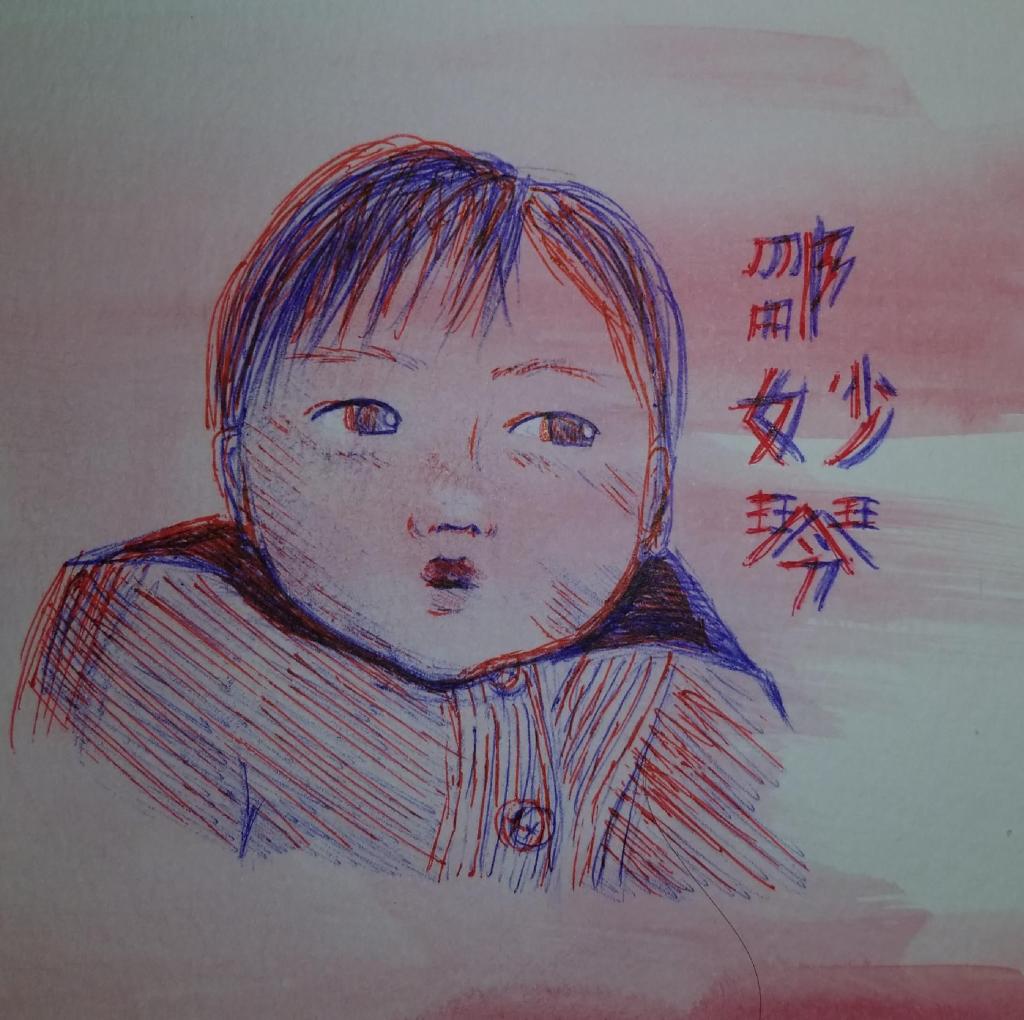
邵妙琴 (Shào Miào Qín): A New Name
This is the name I was given at the ShaoYang City Social Welfare Institute. Shaoyang is the city I lived in and the surname I was given. 妙琴 roughly translates to “beautiful instrument.” I wonder if my parents named me before they gave me away. I wonder why my caretakers at the orphanage chose this name for me. My Chinese name is now my second middle name. I still identify with my Chinese surname, but I wonder if I have the right to. I don’t have many memories of my birthplace. Will going back to China fix that? No. But I want to know more.
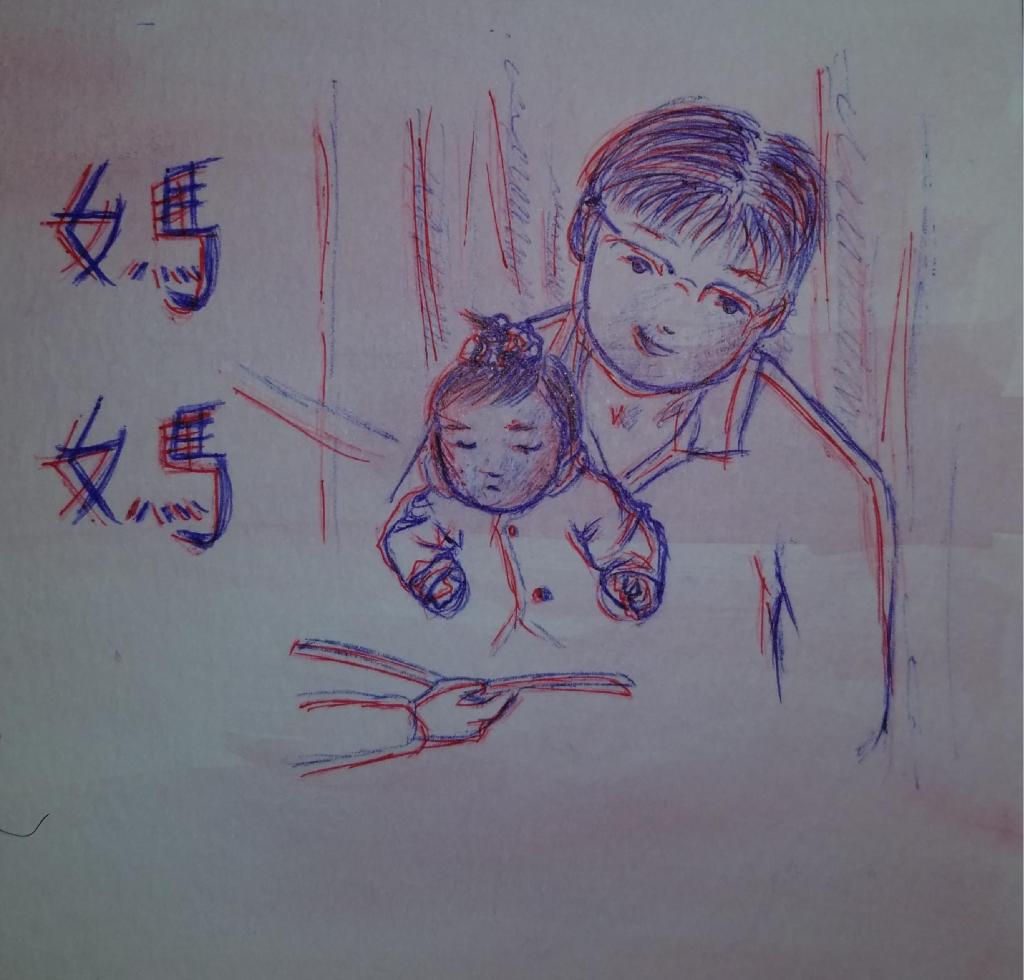
妈妈 (Māmā): A New Relationship
I don’t have any memories of when I initially met my mom. But I know that I’m very grateful for her now. Although we had a lot of problems when I was younger, she is still my family. Being an adoptee means that you may not know any blood relations, so those biological ties don’t limit who you call family. I get to choose who I let into my life and that realization has been revolutionary. I’ve had a lot of important people in my life and many of them have been mother-figures in different ways. My third-grade teacher who helped me love reading. My friend’s mom who always let me eat dinner with them. My high school English teacher who let me stay in her classroom while my mom was working. The list goes on. Not everyone has a nuclear family, but that doesn’t mean your chosen family isn’t just as valuable.
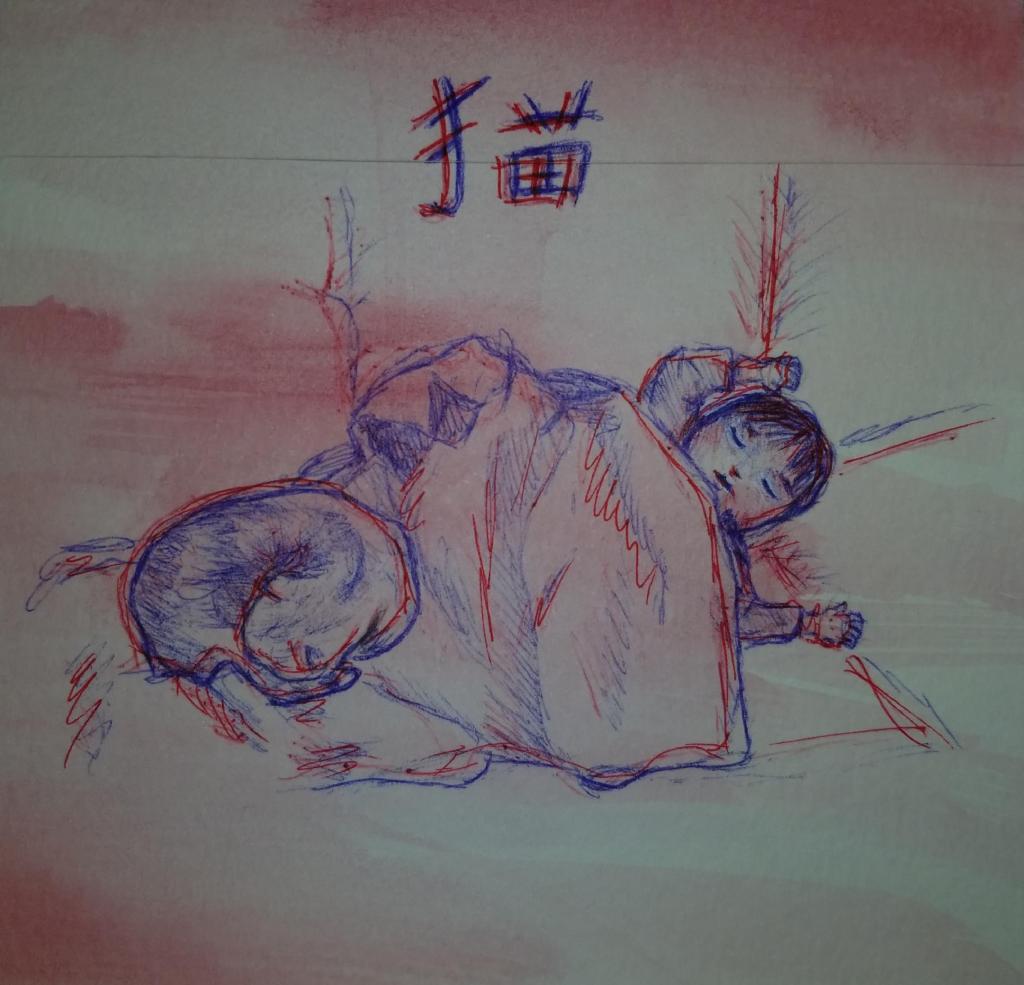
猫 (Māo): Cat
When my mom adopted me, she thought that the 妙 (Miào) part of my name was funny because she had so many cats. I had never seen domesticated animals before, so I cried and cried when I saw Simon, the orange tabby cat. He didn’t care though. He just stared at me while I screamed at him at the range only toddlers can hit. But I grew to love him. He lived until he was 20. I grew up with him. He was there when I came back from my lead poisoning treatments when I came to the states, when I graduated middle school, and when I just wanted to lay on him like a pillow. But change is inevitable. You miss the people and things and pets who used to be in your life. And that’s okay.
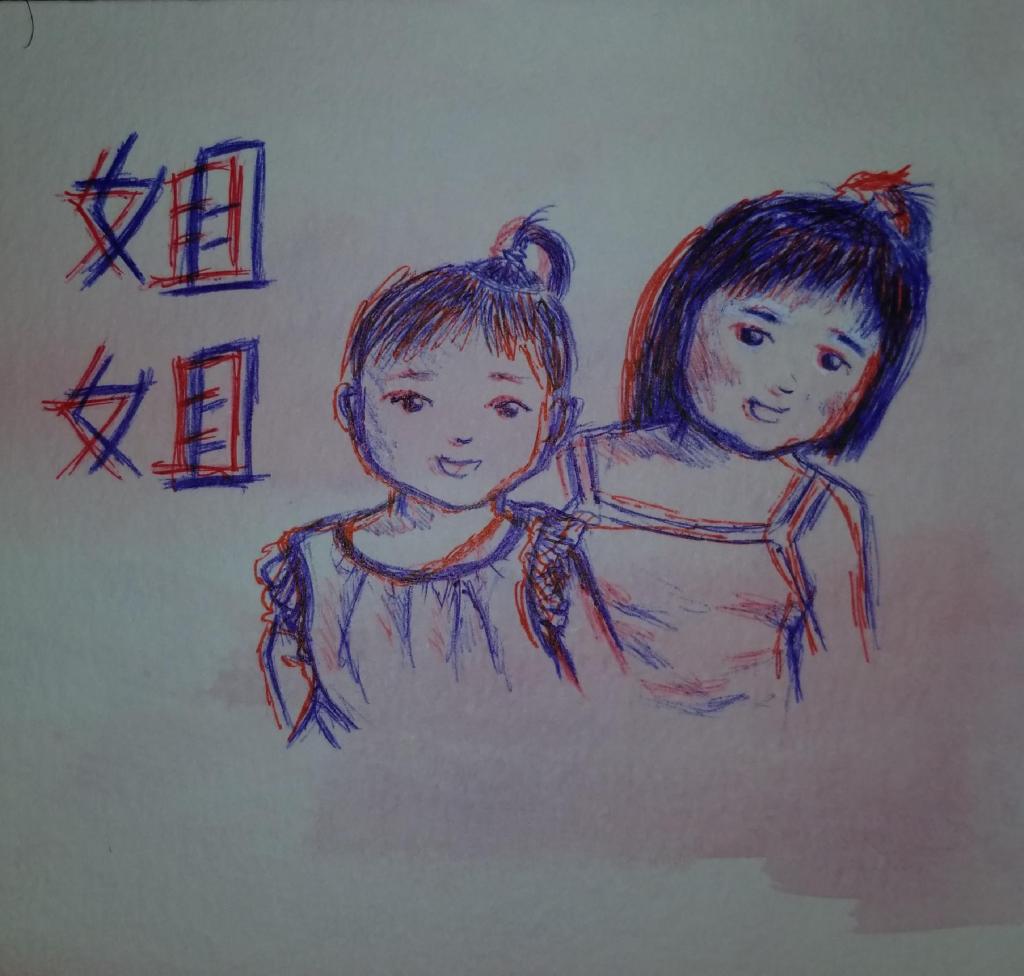
姐姐 (Jiějiě): Older sister
When my sister came to my mom’s hotel room in China, she cried for hours banging on the door and crying for the nanny who had taken care of her at the orphanage. There’s inherent trauma in being adopted. You’re constantly being separated from the people who you thought would take care of you. Who you thought would stay in your life. Who you trusted. And it’s hard. It’s okay to be sad. It’s okay to talk about the hard things that many people gloss over when it comes to adoption. Your adoptive family isn’t perfect. I’m sorry I was mean to my sister when I was adopted. I’m sorry I wasn’t always there for her. I’m trying my best now and I know that doesn’t make up for the past, but I promise I’ll keep loving you.
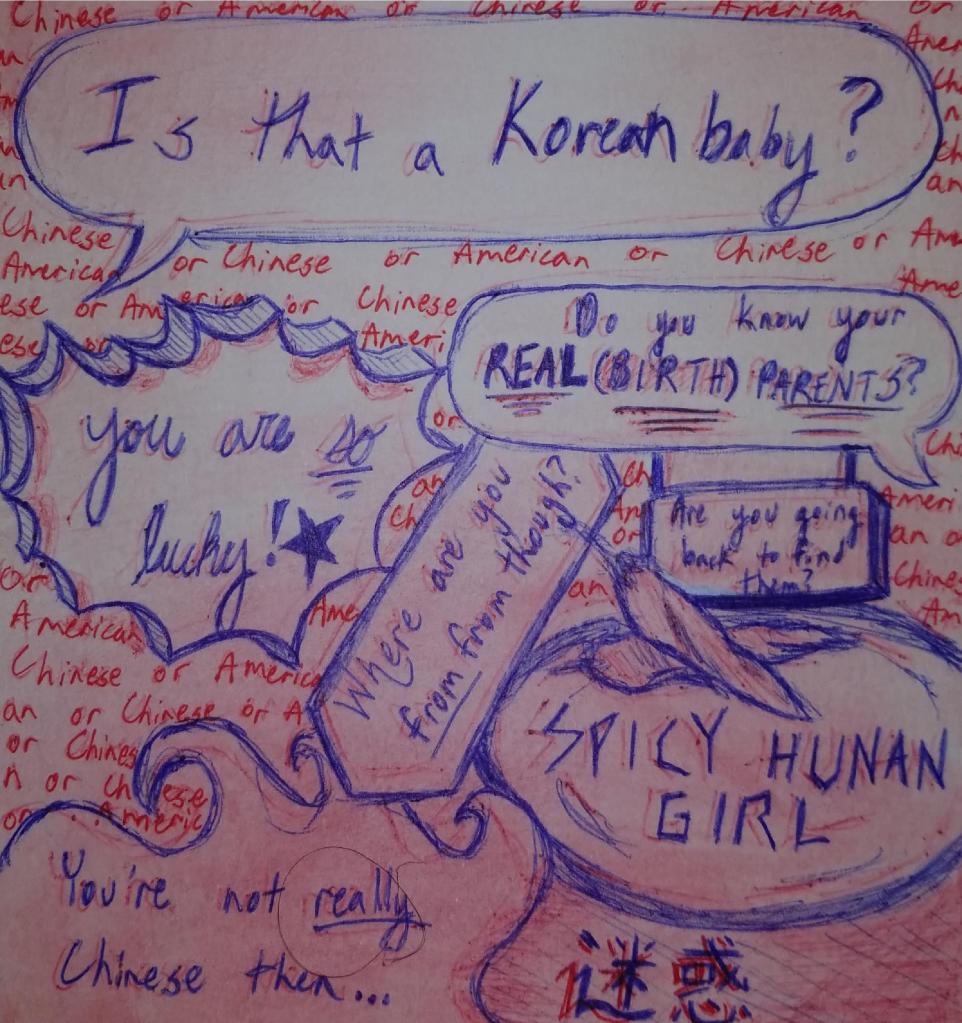
迷惑 (Míhuò): Confused; Puzzled; Baffled
There will be a lot of questions when you have a child in your life. Adoption complicates it a little more. I wish that my mom had thought more about what it meant to adopt internationally and the implications of a transracial family. I wish I had more resources when I was younger to learn about Chinese culture or had money to do a birth family search. I wish I had an older transnational adoptee to talk to. I wish people weren’t discriminatory and laws weren’t racist/xenophobic and people wouldn’t keep asking me questions I don’t have answers to. It’s not that I’m ungrateful, but I would have avoided so much pain and confusion if things were different.
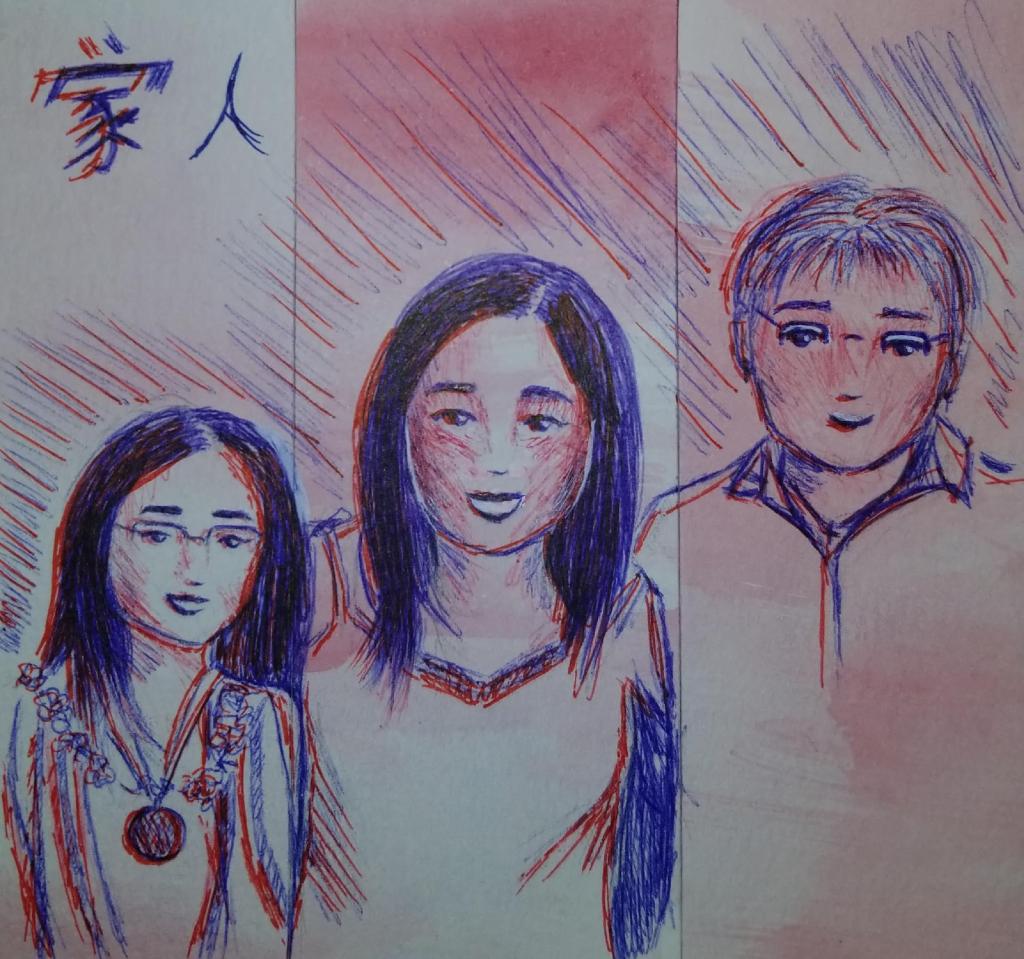
家人 (Jiārén): Family
It’s complicated. There is no right way to have a family and nobody has a perfect family. You’ll grow up learning how to make your own family comprised of friends, teachers, and so many more wonderful people. I wish I had more photos with my mom. I wish I had more photos of when my sister and I were younger. But that’s okay. I’m working through it. Although there are regrets and wishes, I’m coming to terms with what I have now and what I can do next.
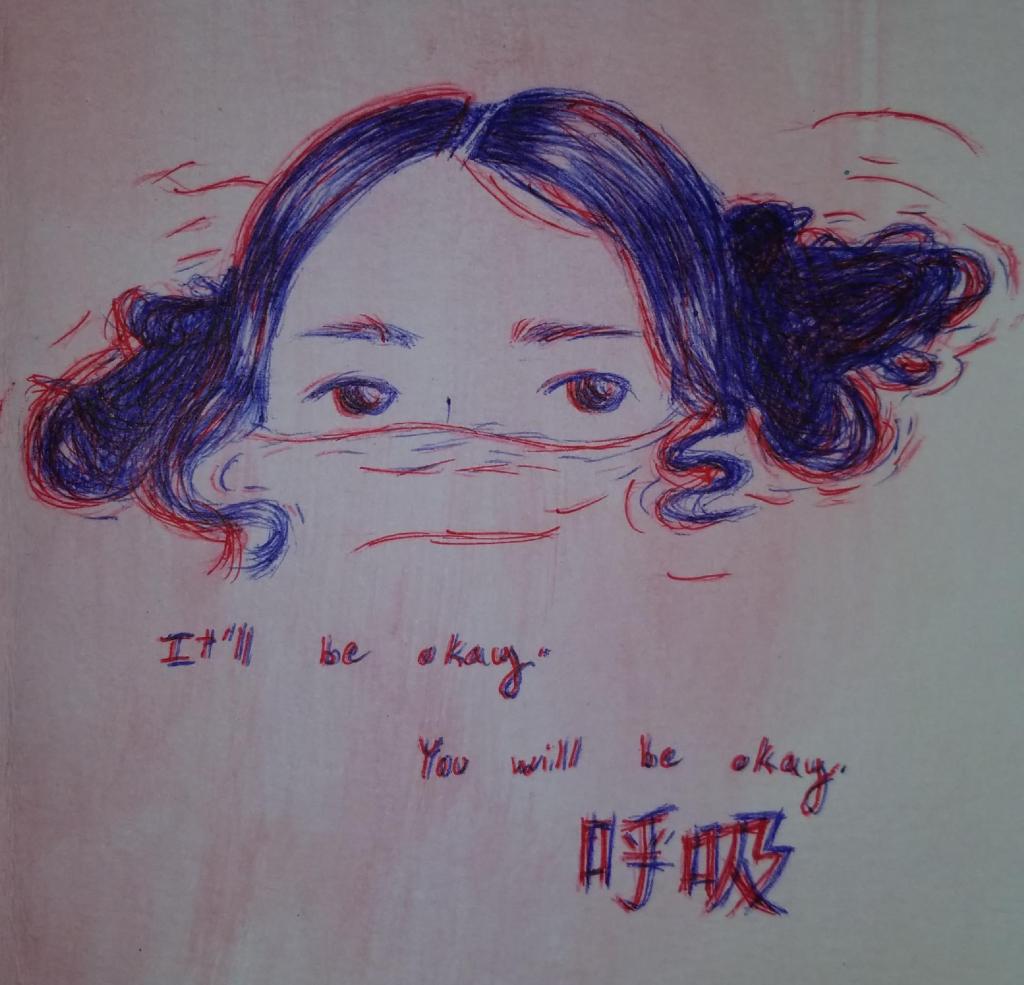
呼吸 (Hūxī): Breathe
Put your health and well-being first. Don’t get caught up in the large-scale problems of the world all of the time or you’ll forget to take care of yourself. Do things that make you happy. Journal. Paint. Write papers about topics you care about. Don’t feel pressure to conform to any expectations because who you are right now is enough. Keep learning. Find time to be with friends, even if you’re calling and it’s silent on both ends of the phone. Remember that people love you and that you are worthy of having your needs met. It’ll be okay. You will be okay.
Larger Picture Questions:
During my presentation on “I Love You Like Crazy Cakes” (ILYLCC) I knew I wanted to do a project focused on adoption, but from an adoptee’s perspective. Growing up I never read any books written by people who were also adopted; the authors were either a parent of adoptees or had no personal ties to adoption.
The plot of ILYLCC is linear and simple. The mom wants to adopt a baby from China, the baby and mom have an instant connection, and the baby is supposedly happy in the US. I wanted to complicate this narrative. There are a lot of mixed feelings that adoptees experience as they grow up and as a transracial, transnational adoptee myself I thought it was time for me to share my own experiences.
Once the Once Child Policy was enforced in 1980, many children were given up for adoption or abandoned. The population control police would fine families if they violated the restrictions, although there were exceptions for more rural areas or if the first child was a daughter. I watched One Child Nation directed by Nanfu Wang and Jialing Zhang, both of whom were born while the policy was in effect, but didn’t realize the repercussions until they were adults. The documentary mentioned the province that I was born in and goes through how child trafficking, abandonment, abortions, and/or not documenting new babies were all decisions families had to make at the time. Forced sterilizations were also common if a woman already had children. Nearly 120,000 children were adopted by international parents and the peak wave of abandonment occurred in the 1990s.
At the same time, America was having an increase in international adoptions. From the 1950s to the 1960s, the Civil Rights Movement was building up and interracial domestic adoption was a contested topic. Then the International Social Service-USA was created and adoption from China, Vietnam, and South Korea boomed, particularly for white adoptive parents. The Americanization of adopted Asian babies was pushed by the government and local media. This helped assuage the fears of some Americans; if these babies born in Communist/foreign/threatening countries could be assimilated into American culture, then there must be something positive about international adoption.
The white savior narrative is something that I wanted to challenge with this project. I want to tell it from my perspective and not allow the romanticization of adoption to be at the forefront. A transracial adoptee I follow on Instagram (@adopteelilly) said: “I can love my adoptive family and be thankful for them while not being grateful for the circumstances that brought us together.” This resonated with me and I wanted to explore my own thoughts and feelings about the situation.
I wanted to resist the common tropes of a loving birth mother, the objectification of the adoptee, predestination, and glossing over the initial adoption adjustment. It was hard because a lot of my illustrations are based on pictures my mom or the orphanage took, which are mostly trying to depict me and my sister as “good kids.” But I still feel like I fall into the Cult of Motherhood trope from the 1850s with the idea of mothers being the keeper of wisdom, bringer of beauty, and emotional heart of the family isn’t exactly how I see my mom. But she also was the only guardian I’ve ever had.
In the children’s literature we’ve gone over in class, I have connected most to the “problem novel,” where characters are often from lower-class families and the authors have a more realistic depiction of a child/teen’s life. Racism, identity crises, suicide, and other heavy topics are struggles that kids should have space to talk about. This only really became popular during the 70s and 80s, but I think it’s important to start talking about these topics as soon as children begin questioning them, if not before. Understanding that the world isn’t a fair place and that sometimes you don’t get what you deserve is hard to take. But that doesn’t mean there aren’t people you love you and resources for you to try to live your best life regardless. Question the world you live in. Resist oppressive structures. Take time for yourself. Take time for your loved ones.
Reflection
I created this piece to reflect on my adoption and what I wish I had been told when I was younger. I wanted to complicate the narrative of a smooth and idyllic interracial adoptive family. Although many children’s books around adoption normalize varying family structures, it is hard having two transnational adoptees come to live with an older single mother. Sharing my narrative is something I haven’t felt comfortable doing ever and having this outlet to express what I’ve been through and the struggles of my life as an adoptee was very therapeutic.
I do wish I had more detailed journals of my mom’s experiences going through my sister’s adoption. Reading her log on the events leading up to my adoption and the photos she included made me miss home a lot more than I imagined. But I wonder how her thought-process evolved when she went to adopt my sister. My sister was adopted right after 9/11 happened and she talks about how it was a struggle going through airport security with a “foreign” child. These small illustrations don’t connect directly to the Civil Rights Movement in America, the post 9/11 criminalization of Muslim Americans or the Asian American activists that I look up to. But they aren’t separated from that either. Identity is inherently political.
I would add additional panels about how receiving a more holistic education around American history increased my drive to participate in advocacy work and how it helped shape my current understanding of being an Asian American, a Chinese adoptee, and a documented citizen of the US. I’d want to add more about learning about how international adoption fits into the larger picture of population control in China and why America’s international adoption skyrocketed.
I also cut a few pages wrong, so I taped them back together, but I feel like visually it’s okay. Art is something that I have always enjoyed and being able to reflect on old photos was really therapeutic in some ways. Overall, I’m satisfied with this piece, but I know that I’ll keep adding to it and going back to it. My thoughts on adoption have changed so much over the years and I know they will continue to evolve. Self-reflection never stops.


 邵的旅程
邵的旅程 
You must be logged in to post a comment.